
A tearful tribute to the Uncommon Man
R. K. Laxman, one of the world’s greatest cartoonists passes away
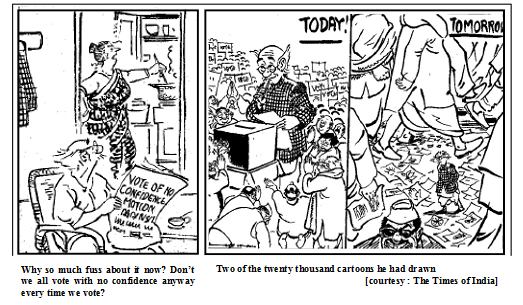
Two of the twenty thousand cartoons he had drawn
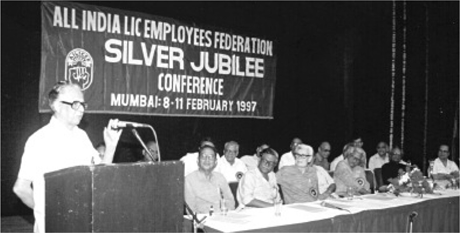
Federation felicitated R. K. Laxman at its Silver Jubilee Conferencce held in Mumbai in February 1997 with thunderous applause from the vast gathering.
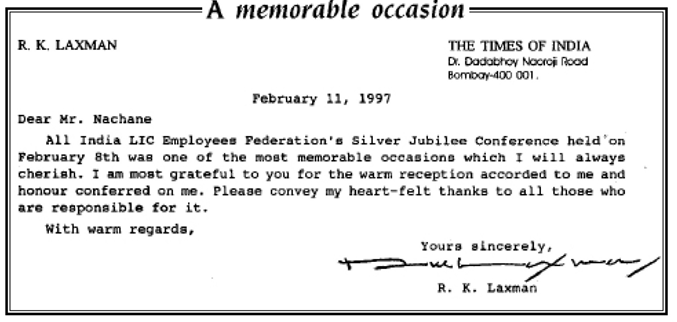
The uncommon man – editorial in Vima Kamgar (June 1998)
“While our political leaders have not improved the common man’s quality of life, they have certainly helped improve the quality of cartooning in India, especially mine. “expressed eloquently the inimitable Rasipuram Krishnaswamy Laxman. The occasion was the publication of “Fifty years of Independence through the eyes of R. K. Laxman.” a compilation of 200 select cartoons painstakingly picked out by Kumar Ketkar. the editor of Maharashtra Times from the cartoonist’s 20,000 masterpieces.
This great cartoonist who began drawing at the age of three says, “What you see of human face is only a mask, behind it is an animated object like a tiger or a crow: sometimes it is also an inanimate object-some people look like brokendown trucks or buildings; you have to have extra-ordinary vision to see what is going on behind the face which is presented to the society.”
If Tansen became Nad-Siddha with tremendous occult power, R. K. Laxman attained this extra-ordinary vision through a constant observation and profound study of the happenings in circus-like politics and the life and living of the common man. He himself observes : “There is still much to laugh at in the world and it is increasing for those who care to laugh despite the bickerings among the superpowers, nuclear proliferation, terrorism, corruption at high places and so on. All these grave threats to peace and our very existence sound remote and feeble over the din of voices around the layman, complaining about the immediate problems of pot-holes and power shortage, the water crisis, soaring prices, strikes and traffic jams. A leaky tap in the bathroom is of greater concern to him than the failure of the Summit. He is much more bothered by the rise in the cost of toothpaste and tomatoes than the deficit in our foreign exchange reserves.” It is such constant observation with an acute sense of humour and steadily maturing understanding of the mechanics of politics that bestowed on him supernatural power to turn the great actors on the political stage into amusing caricatures, whether it is larger than life portrayal of Jayalalitha or Advani wearing a small crown that looks like a child’s toy.
All this is to the delight of common man who starts laughing at the ironies and paradoxes of what goes on in the name of politics.
There is an interesting story of how Charlie Chaplin invented his Tramp. Charlie had an accidental meeting with a hobo in a street of San Francisco, appearing hungry and sullen. He took him to a nearby restaurant and gave him lot of drinks and food. The man thereafter started telling his story of life-long jaunts through the beautiful country and his misfortunes, with the simplicity of a farmer. Charlie was delighted to gather from the conversation the revelations of his character and watch his gestures, his facial expressions. And Charlie developed the whole idea of the Tramp.
The origin of Laxman’s common man is not exactly clear. Referring to innumerable incidents after independence the cartoonist says, “he (Common Man) looked for me and walked into my cartoons quietly without my even knowing about it and he has stayed on for all these years.” Whatever might be. Laxman’s cartoons continue to reflect his exalted, personal expression of union with this Common Man whom he has made immortal. The cartooning which slowly appeared in India in this century was mostly in the form of lampooning the British rulers. K. Shankara Pillai known as Shankar pioneered cartoon journalism after joining Hindustan Times in 1932 and launched Shankar’s Weekly in 1948. He was a genius but his cartoons were confined to a certain ambit in terms of sketchline and exposure. Laxman continued to scale unknown peaks ever since he started drawing freely political cartoons in The Times of India sometime in 1950. Thereafter he had a long sojourn in England where he met and drew the greatest intellectuals of the period like Bertrand Russell, Anurin Bevan, T. S. Eliot and Lord Atlee. When he returned, the general manager of The Times of India persuaded him to originate a frontpage pocket cartoon and so the Common Man appeared and stayed on.
Laxman’s Common Man is not like Walt Disney’s Micky Mouse or Donald Duck. He represents India’s mute millions, the helpless witness to the marching times. His wife with a typical middle class origin sometimes speaks but he never opens his mouth and his silence is more eloquent. To the critics who say that such cartoons turn the common man away from the path of struggle against the evil-doers he says, “man is a victim of his circumstances in which all doors of escape from tension are shut to him. For such a victim the next best thing is to have a goodhumoured approach to life.” There was a similar criticism about the love dreams shown in Raj Kapoor’s movies to which Raj said that love in its innocent form was the most natural medium to take the man caught in fierce struggles and frustrating experiences in life to a higher plane of thinking where he could understand the true meaning of life. And has not Mazroo Sultanpuri said in his Dekh jinda ke pare range -” Look beyond the prison bars at nature’s bounty/dance if you want to/don’t grumble about the chains/that bind your feet.”
A refreshing reality is that the effect that the devastating exposure of opportunist politicians in Laxman’ s cartoons creates is hundred times more than a thousand speeches. They give a new strength to the common man to question the powers that be, caricatured in cartoons. It is for the well-meaning politicians and working class leaders to use the same as new weapons in their struggles. And with due respect to these respected men let it also be said that if they remain always in a tense mood they will be missing the many-splendoured springs of life. That will also reflect in their attitudes towards the common man who may be an insurance clerk, textile worker, housewife, vendor, slum-dweller or an unemployed turned beggar, the common man who wants to laugh heartily and live vivaciously even in adverse circumstances. And finally, looking at the ever-green cartoonist par excellence we are tempted to quote a proverb: “Here’s God’s plenty!”